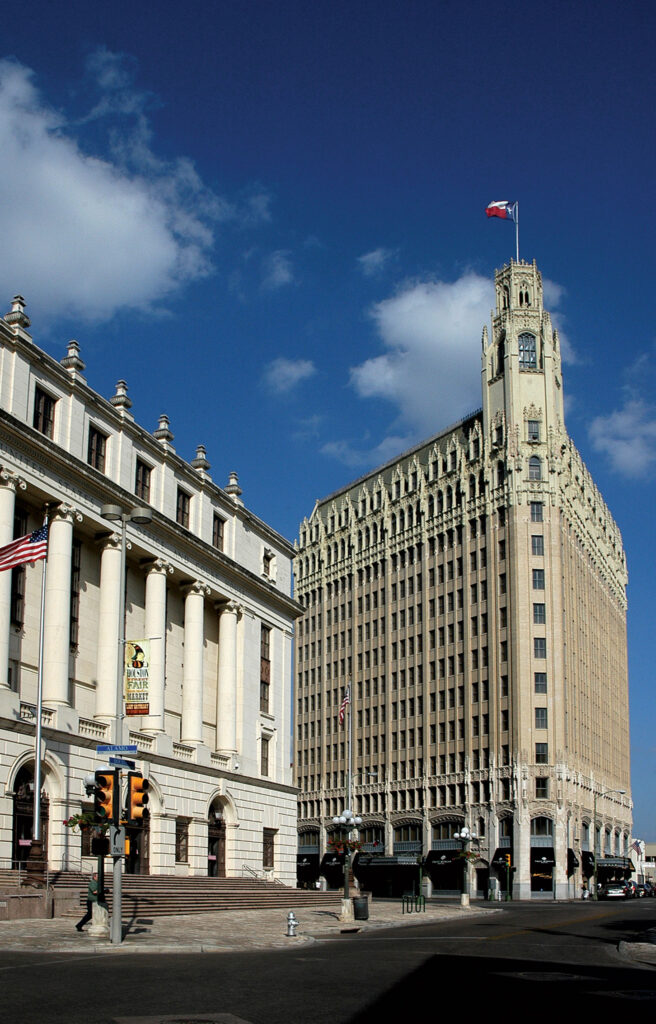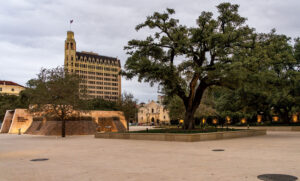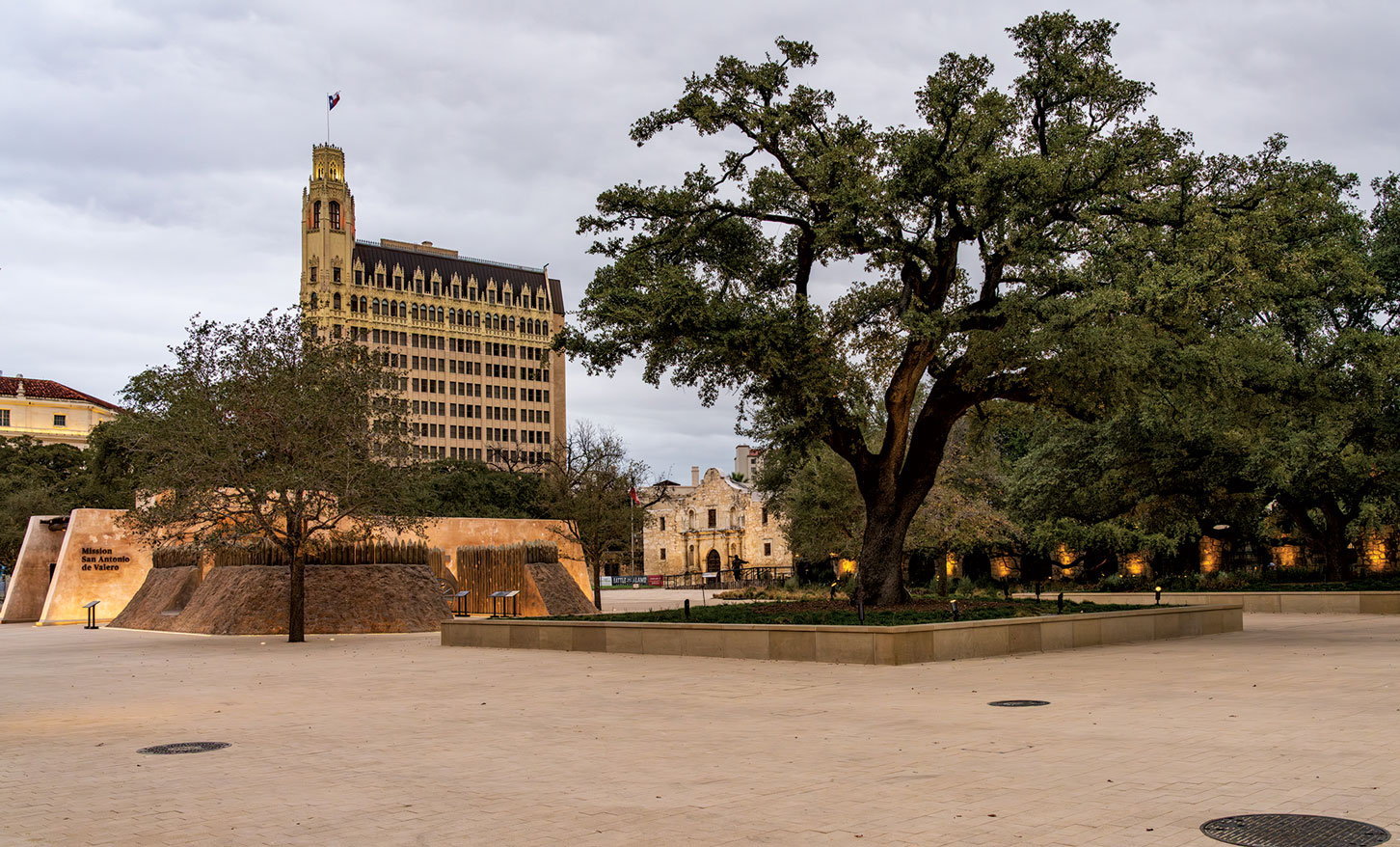
Originally opened in 1926 as the Medical Arts Building, it captured the optimism and ambition of a rapidly growing San Antonio. A century later, it remains a prominent part of the skyline, recognized as one of Texas’ best-preserved Neo-Gothic commercial structures. Its distinctive shape is as iconic to the San Antonio skyline as the Alamo itself, and stories of unexplained phenomena have elevated it from an architectural treasure to one of America’s most talked-about historic hotels. Whether appreciated for its design, celebrated for its preservation, or sought out by those believing in spirits, the Emily Morgan continues to serve as a true gothic sentinel of San Antonio.
A Monument to Modern Medicine
The decade after World War I saw rapid growth for San Antonio, driven by advancements in transportation, healthcare and commerce that established it as a major city in the Southwest. Healthcare professionals increasingly favored centralized buildings combining offices, labs, pharmacies and hospitals — an innovative idea at the time. Developer Joseph Madison (J.M.) Nix imagined such a structure, collaborating with renowned Texas architect Ralph H. Cameron to create a medical skyscraper that would symbolize stability, elegance and prestige.
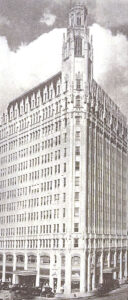
Completed in 1926 at 705 East Houston Street, the Medical Arts Building quickly became an architectural icon of San Antonio. Cameron, also responsible for designing the nearby Hipolito F. Garcia Post Office and Federal Building, regarded this project as one of his best commercial works in the city.
Gothic Architecture Reaches Texas
Although hospitals are typically seen as modern and sleek today, the Medical Arts Building showcased a very different style. In the 1920s across America, Neo-Gothic skyscrapers were immensely popular, with architects drawing inspiration from medieval cathedrals and European castles, reinterpreting ancient forms with modern steel frameworks. This blend resulted in structures that combined advanced engineering with romantic historic elements.
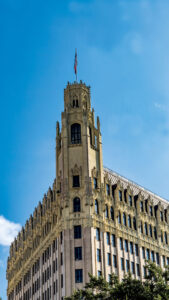
The Medical Arts Building exemplified one of Texas’ best takes on this trend. Its thirteen-story steel-frame structure featured a V-shaped design that sharply rose from Houston Street. The lower two floors are clad in precisely cut limestone with wide arched windows, conveying strength and permanence. Above, light-colored bricks extend upward, decorated with detailed terra-cotta embellishments. Its most distinctive feature is a striking châteauesque corner tower topped with a steep copper mansard roof, supported by exposed wooden ribs. Rising higher still, a church-like spire dominates the skyline, drawing the eyes upward like medieval cathedral towers. Perhaps most treasured are the building’s sculptural details: terra-cotta gargoyles and grotesques peer down from parapets and corners. Unlike traditional medieval monsters, many depict people suffering from various medical issues — such as toothaches, headaches or swollen cheeks — reflecting the building’s original medical purpose. These playful yet meaningful sculptures turn the building into a visual tribute to medicine, acknowledging human ailments while vigilantly watching over the physicians who treat them. Few commercial structures in Texas feature such imaginative architectural symbolism.
 Along the Old Spanish Trail
The Medical Arts Building also played a key role during a significant period of transition in the history of transportation. In the 1920s, the Old Spanish Trail was established as one of America’s major transcontinental highways, running from St. Augustine, Florida, to San Diego, California. Before the interstate system, travelers navigated this famous route across the country. San Antonio, situated at the trail’s midpoint, became one of its main stops.
Thousands of travelers passed right by the Medical Arts Building on their journeys between the Atlantic and Pacific oceans. Many early supporters and organizers of the trail had offices in the building, making it a crucial hub for promoting automobile tourism. As a result, this building became linked to two major 20th-century developments: advances in modern medicine and the rise of automobile travel.
Changing Times
Medicine underwent significant changes in the postwar years. During the 1960s and 1970s, hospitals expanded into large suburban campuses, leaving many downtown medical office buildings uncertain about their future. The Medical Arts Building was among these. By 1976, after serving multiple generations of doctors and patients, it stopped functioning as a medical center and was transformed into modern office spaces. Luckily, this period also saw an increased appreciation for historic preservation. The building’s outstanding architectural value quickly gained recognition, and in 1977, it was included in the Alamo Plaza Historic District on the National Register of Historic Places. It was also designated a local historic landmark, acknowledging its architectural significance and contribution to San Antonio’s skyline. Visitors exploring downtown soon encountered the building as part of the San Antonio Conservation Society’s Texas Star Trail, showcasing one of the city’s most remarkable architectural landmarks. This marked a significant victory for preservation.
From Hospital to Historic Hotel
Adaptive reuse has saved numerous historic buildings across America, and few instances are as successful as the transformation of the Medical Arts Building. In 1984, developers undertook a major renovation, turning the former medical tower into a luxurious hotel. This project was monumental; nearly every interior element was removed and rebuilt to house guest rooms, meeting spaces, restaurants and modernized systems. Despite these changes, the Gothic exterior was carefully preserved, maintaining the building’s architectural identity. The hotel was given a historic name: the Emily Morgan Hotel, honoring Emily D. West, the iconic figure linked to the song “The Yellow Rose of Texas.” Though her story remains debated by historians, her connection to Texas independence made her a fitting namesake for a hotel across from the Alamo. The renovation revitalized a key downtown landmark while keeping its distinctive silhouette.
Recognition for Preservation
Historic preservation succeeds when communities see architectural heritage as both an economic and cultural asset. The Emily Morgan Hotel exemplifies this belief. In 2010, the San Antonio Chapter of the American Institute of Architects awarded it the Twenty-Five Year Distinguished Building Award, highlighting the quality of its adaptive reuse and Ralph Cameron’s timeless design. Just two years later, the hotel reached another milestone. After a multimillion-dollar renovation completed in December 2012, it became part of the DoubleTree by Hilton, blending modern hospitality with its historic character. The hotel also joined Historic Hotels Worldwide, an organization dedicated to promoting heritage tourism and conserving historic hotels globally. In 2015, it was inducted into the Historic Hotels of America, recognizing its importance as a historic site showcasing the nation’s architectural and cultural legacy. A century after its original construction, the former Medical Arts Building continues to find new purpose while honoring its rich history.
The Haunted Reputation
The Emily Morgan’s lasting fame cannot be attributed solely to its architecture. Few historic Texas hotels are widely known for paranormal activity. Its proximity to the Alamo has sparked numerous ghost stories, with visitors dating back to the nineteenth century reporting strange sounds, apparitions and eerie sensations around the historic district near the old mission. The hotel’s vantage point over the battlefield has become intertwined with these legends. Both guests and staff have described strange happenings — elevators stopping on seemingly empty floors, unexplained footsteps, lights flickering without reason, doors opening on their own and the feeling of unseen presences. Some have seen shadowy figures in period attire, while others hear voices in empty hallways. The upper floors, especially the fourteenth, the number assigned despite the building’s original thirteen stories — are notorious among paranormal fans for unexplained activity. Skeptics suggest suggestibility, architecture, old machinery or expectations as explanations, but believers see the hotel’s long history, its dual role as hospital and hotel, and its location by the Alamo as creating a perfect setting for paranormal encounters. Regardless of viewpoint, the stories persist. Paranormal investigation shows and travel writers frequently highlight the hotel as one of America’s most haunted. These legends have become a defining part of the hotel’s identity.
More Than Ghost Stories
Although often seen simply as a haunted hotel, the Emily Morgan holds much greater significance. Architecturally, it remains one of Texas’ premier Neo-Gothic skyscrapers. Historically, it marks a pivotal chapter in the development of American healthcare, urban growth, automobile tourism and historic preservation. Culturally, it showcases how adaptive reuse can conserve architectural masterpieces while infusing them with new vitality. Its gargoyles still peer over Alamo Plaza, its copper roof gleams in the Texas morning sun, and its tower remains a key feature of San Antonio’s skyline. Visitors today walk through renovated spaces designed for hospitality, yet they stand in a building that once housed pioneering physicians, travelers on the Old Spanish Trail, preservationists saving historic architecture and generations of San Antonians.
 A Gothic Guardian Endures
As San Antonio continues to grow, the Emily Morgan Hotel remains a steadfast observer of one of Texas’ most historic intersections. Its towering Gothic structure is a reminder that a city’s character is shaped not only by battlefields and monuments but also by the remarkable buildings that silently observe history as it happens. The former Medical Arts Building has endured changing medical practices, shifts in economic fortunes, urban renewal and a century of development. Through careful preservation, it has stayed relevant while preserving Ralph H. Cameron’s original architectural vision from 1926.
Today, its gargoyles continue their silent watch over Houston Street, just as they have for generations. Their weathered faces have witnessed physicians rushing to appointments, motorists traveling the Old Spanish Trail, preservationists saving landmarks, hotel guests checking into elegant rooms, and visitors admiring one of San Antonio’s most distinctive buildings. Whether celebrated as an architectural masterpiece, a preservation success or one of America’s most fascinating haunted hotels, the Emily Morgan is more than a place to stay. It stands as a monument to the enduring power of architecture, a guardian of memory overlooking the Alamo and one of Texas’ most iconic gothic landmarks.