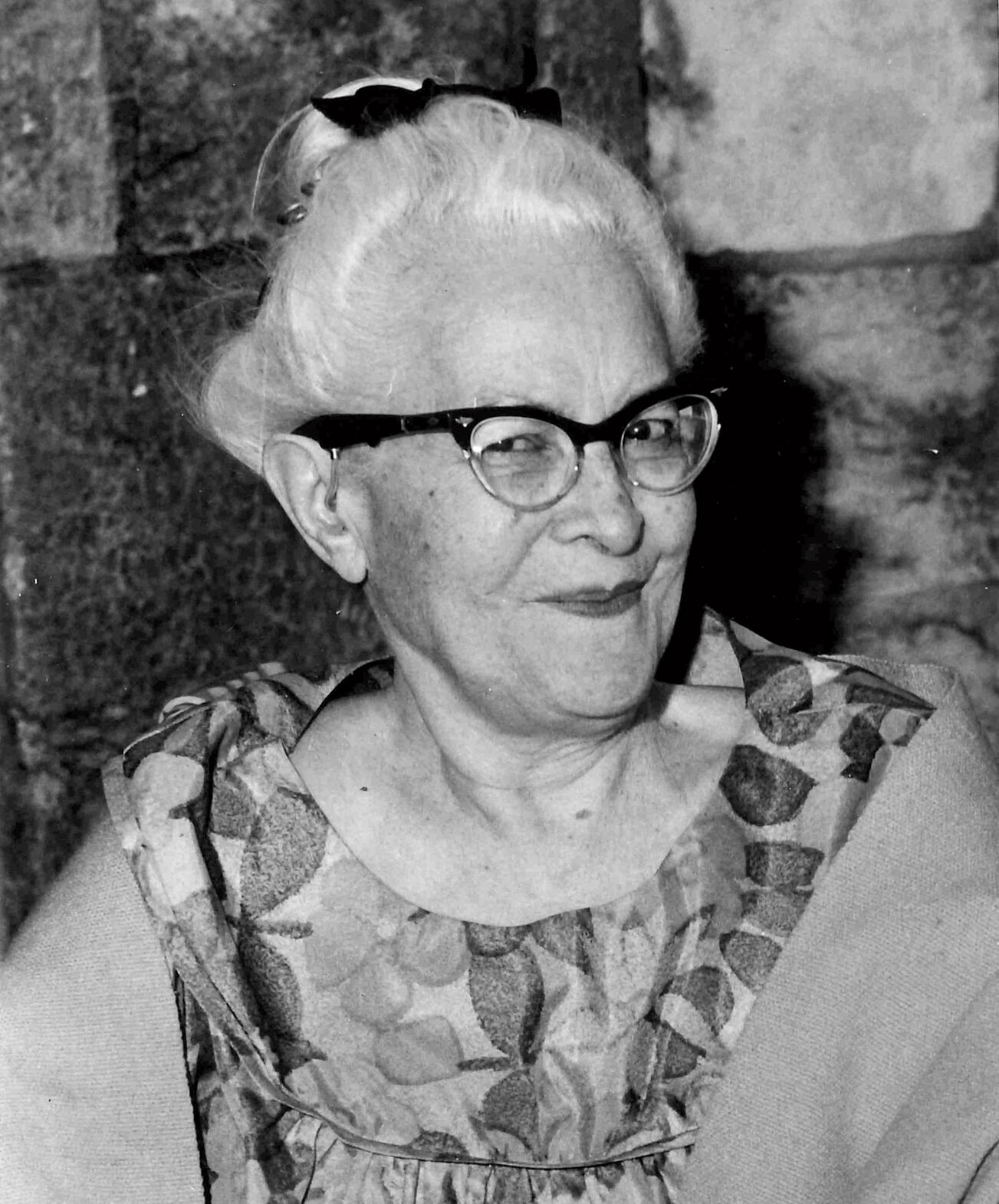
Emily Edwards

Artist and Conservationist

By:

Photo courtesy of The Conservation Society of San Antonio.

Born in San Antonio on October 7, 1888, she started drawing sketches at 10 years of age while at the Ursuline Academy, where she was boarded after her mother passed away. She began formal art studies at the San Antonio Female Institute with sculptor Pompeo Coppini in 1902, before moving to Chicago in 1905 to continue her education at the Art Institute of Chicago.

By her second year at the prestigious school, she began teaching at the Institute to help pay for her tuition, and soon she started teaching at Hull House as a volunteer. She would go on to teach at various schools for girls and at the Francis Parker School, where she taught until 1917 when she returned to San Antonio. Back at home, she continued her teaching career at Brackenridge High School, and in 1920 she taught at a mountain mission in Charles Town, West Virginia. Later, she expanded her creative skills by working as a stage designer in New York City and performing as a puppeteer in Massachusetts, which later would prove crucial for her role in conservation. 

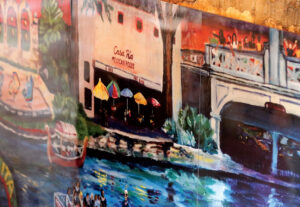
She returned to San Antonio in the early 1920s, and in 1924 joined forces with Rena Maverick Green to assemble a group of prominent San Antonians to prevent the paving over of a section of the San Antonio River. Edwards used her artistic skills to put on a puppet show for city commissioners — an interpretation of the fable “The Goose and the Golden Eggs,” in which the goose represented the river, and the eggs represented aspects of city culture that benefited from the river. Her persuasive display won the commissioners over, and that section of the river is now known as the San Antonio River Walk. 

This important victory led to the formalization of the Conservation Society, for which she served as its first president from 1924 to 1926. Leaving the Society in capable hands, she continued her artistic pursuit, spending the next decade traveling frequently to Mexico to study with famed muralist Diego Rivera, which whom she forged a lasting friendship. From the 1950s onward, Edwards spent the rest of her life in San Antonio, where she died on February 16, 1980.

Emily Edwards is one of the most important figures to credit for the preservation of San Antonio’s invaluable history, architecture and cultural diversity, paving the way for generations to come. 
Visual Arts

The Brackenridge Park Conservancy Art Walk

Brackenridge Park has long been one of San Antonio’s most beloved public spaces — and one of the most culturally and archaeologically significant landscapes in the United States, weaving together Indigenous heritage, Spanish colonial engineering, industrial development, philanthropy and major public works projects.

Read More »
Culture

Remember The Alamo

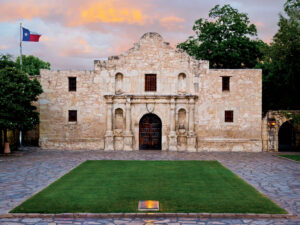
Today, most people think of the Alamo as a single structure: the limestone church rising from Alamo Plaza, solemn and self-contained. But that familiar image is the product of survival, accident and later choices — not historical reality.

Read More »
Visual Arts

Head West

Each spring, the American West comes vividly to life in downtown San Antonio, and this year, the moment carries special significance. The Night of Artists at the Briscoe Western Art Museum marks its 25th anniversary — an important milestone for one of the premier Western art exhibitions and sales in the world, and a must-see experience for locals and visitors alike.

Read More »
Fiesta

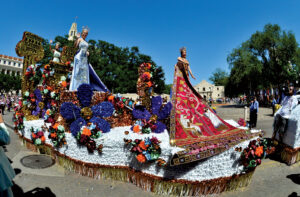
Petals, Pageantry and the Heart of Fiesta

“Show us your shoes!”
The chant rises from the gleeful crowd as flower-covered floats approach the Alamo. Confetti drifts across downtown streets. Bands strike up familiar marches. Women in sweeping gowns lift their skirts to reveal sneakers, glittering heels, decorated boots, flip-flops and fuzzy house shoes. The moment is playful, joyful and unmistakably San Antonio.

Read More »
Performing Arts

A City in Harmony

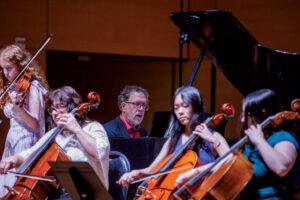
San Antonio’s cultural roots run deep, but in recent years, something unexpected has been happening in its performing arts ecosystem. Beyond large-scale productions and the familiar rhythms of mariachi and Tejano, a quieter revolution, built on intimacy, virtuosity and the power of small ensembles, has been slowly unfolding. Chamber music, once considered a niche corner of the classical world, is experiencing a full-fledged renaissance in the Alamo City.

Read More »
Editor's Letter

Where Color, Culture and Creativity Collide

San Antonio has always been a city that celebrates itself with color, rhythm and a kind of joyful defiance. Fiesta rolls in every spring like a technicolor tornado, and the city becomes a living canvas — part parade, part performance, part communal heartbeat — all while scattering confetti in places you’ll still be finding in October. But beneath the confetti and cascarones lies a deeper story about how art and culture thrive here year-round — shaped by neighborhoods, nurtured by tradition and constantly reinvented by the people who call this place home.

Read More »

Culinary Arts Listings